










Singapore provider check · buyer guide
Fast answer: verify the route, not only the company name
A legitimate provider should make five things clear before collection: who you are dealing with, what the items are, how access changes the work, what the written quote includes and which collection or downstream route applies.
Move Move Movers uses a scope-first disposal process: classify the items, assess access, record the agreed work and keep responsibility visible. For availability and a job-specific assessment, start with Move Move’s Singapore disposal options.
Customers may describe the same enquiry as bulky-item removal, rubbish removal, furniture disposal, commercial clearance support or waste-management support. The label does not remove the need to check the actual items and route.
This guide helps a customer verify the service. It does not turn an ACRA registration, a review screenshot or a marketing label into proof of every licence, facility, environmental outcome or job inclusion.
The five-part legitimacy check
What to verify before anyone loads the items
Legitimacy is an operating chain. A credible quote connects the business identity to the accepted items, physical access, commercial scope and appropriate handover.
- 01Identity check
Business identity
Match the entity name, contact details, quotation and payment instructions. ACRA’s Bizfile search guide explains how to check a name or UEN and view basic information.
- 02Acceptance check
Item and waste stream
List furniture, appliances, electronics, renovation material, mixed rubbish and anything chemical or industrial separately. One generic “disposal” label is not enough to select the route.
- 03Site check
Access and removal method
Confirm lift or stairs, corridor and loading distance, building rules, item dimensions, dismantling and the safe carrying path. These facts can change time, manpower and vehicle space.
- 04Commercial check
Written price and scope
Ask whether the price is based on individual items, volume, truck space, manpower, access or a combined job. Record what is included, excluded and treated as a change.
- 05Route check
Collection and downstream responsibility
Ask who accepts the items, which appropriate route applies and what record or handover confirms completion. A sales message should not leave that responsibility ambiguous.
Different items · different routes
Do not put every unwanted item into one disposal category
Singapore’s public guidance separates general waste, regulated e-waste and toxic industrial waste. Move Move’s customer-facing standard is to identify the actual item group first, then confirm what the accepted scope can handle.
Furniture still fit for use
Consider repair, resale or donation when condition and acceptance make that practical. NEA lists current donation, resale and repair channels; acceptance is controlled by the receiving organisation.
Unwanted furniture and bulky inorganic items
NEA’s general waste collection system places unwanted furniture and other bulky non-putrefiable waste within Class A. Confirm the actual collector and downstream route for the accepted job.
Electrical and electronic products
Regulated consumer e-waste uses dedicated collection channels. Check NEA’s current e-waste channels and Move Move’s appliance and e-waste disposal guide.
Toxic or industrial waste
Do not treat chemicals, scheduled toxic industrial waste or unknown industrial residue as ordinary bulky disposal. NEA’s toxic waste controls describe separate licensing and transport requirements.
Fixtures and renovation-linked materials
Clarify ownership, landlord or contractor responsibility, disconnection, dismantling and the appropriate route before removal. Do not assume built-in work or renovation debris is included in ordinary furniture collection.
Quote clarity · before price confirmation
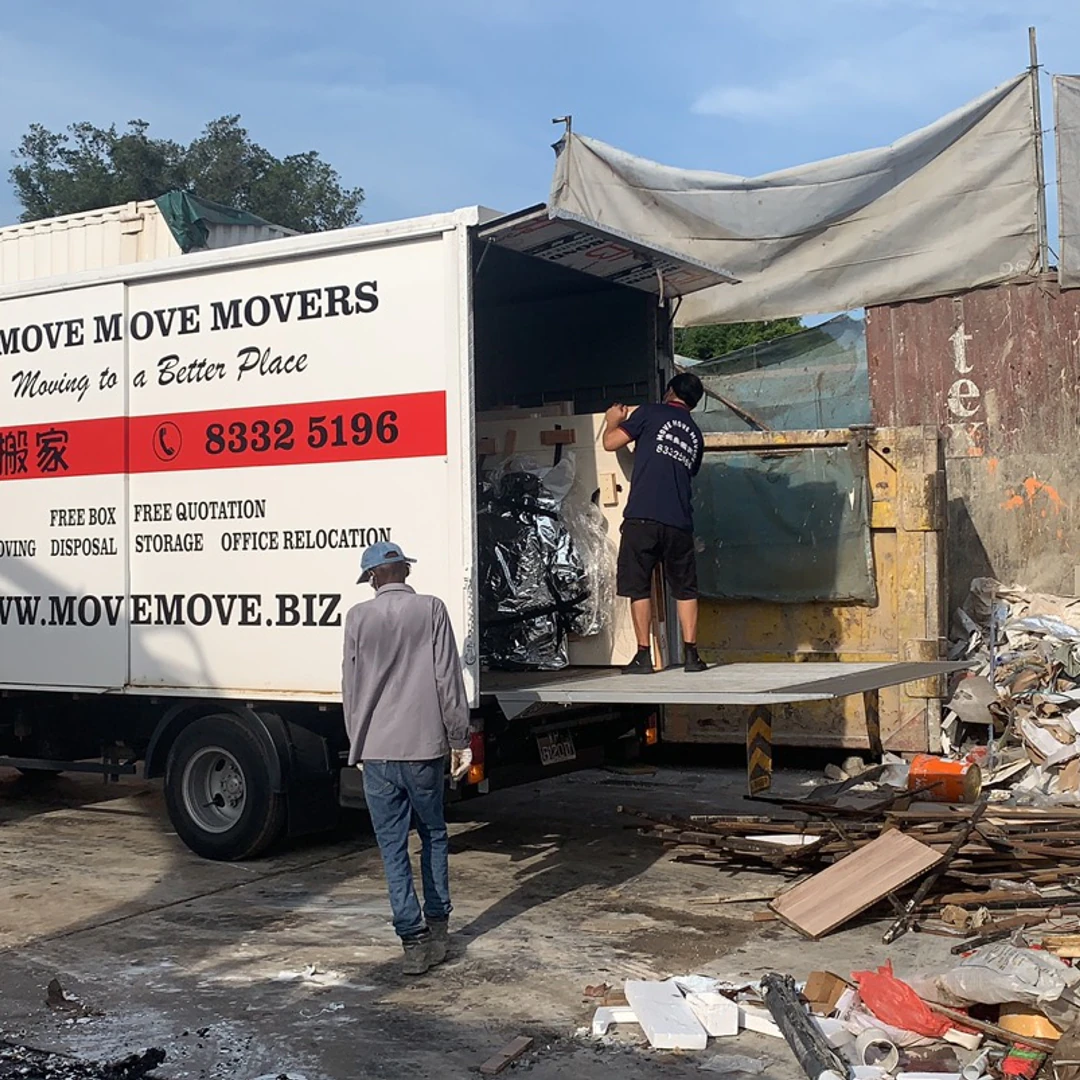
A professional quote shows why the price changes
Price is useful only when the assumptions are visible. An item-only job, a half-load or full-load clearance, stairs, long carrying distance, dismantling and a mixed waste stream are different scopes even when the word “disposal” is the same.
Send these inputs
- clear photos and quantity of every item group
- dimensions for oversized or route-sensitive pieces
- property type, floor, lift, stairs and loading position
- dismantling, disconnection or carrying needs
- building rules, preferred date and time constraints
- separate move, storage, reuse and disposal lists
Confirm these outputs
- accepted and excluded items
- price basis and included disposal-related charges
- manpower, vehicle or volume basis where relevant
- access, carrying and dismantling assumptions
- change, cancellation and additional-work process
- collection window and downstream responsibility
Scope boundary: current availability, final price, manpower, vehicle, timing, accepted items, collection route and inclusions belong in the accepted quotation. This guide is not a fixed-price package or a guarantee that every item can enter one route.
Official checks · exact boundaries
What the public records prove—and what they do not
Use official sources to verify the role of each authority. This helps separate legal or regulatory requirements from the service scope offered for your own job.
Business identity
ACRA Bizfile supports entity registration and information checks. It does not, by itself, prove a waste-collection licence, service quality, environmental result, price or insurance position.
Waste route
NEA’s waste collection information supports general-waste classes and licensed-collector context. It does not automatically prove that any mover or quotation holds a particular licence or accepts every item.
Separate streams
NEA’s e-waste and toxic-waste pages support separate regulated routes. They do not make a general furniture quotation an e-waste, hazardous-waste or industrial-waste acceptance.
Move Move scope
Move Move’s public page and accepted quotation should state what the team will assess and handle. They should not be read as regulator endorsement or as a universal licence, recycling-rate guarantee or blanket “eco-friendly disposal” promise.
Move Move Movers · precise service routing
Choose the disposal owner that matches the items
Strong service coverage is useful when each page has a clear job. Start broad, then use the specific route when the inventory makes it relevant.
General disposal assessment
Use the main disposal overview for a mixed household or business enquiry and to submit the initial inventory, photos and access details.
Furniture disposal
Route sofas, mattresses, cabinets, tables and other bulky furniture to the assessed furniture removal page, subject to item and access confirmation.
Office disposal
Keep office furniture, ICT equipment, confidential records, landlord-controlled fixtures and regulated items in separate lists. Start disposal-heavy commercial work through the office disposal page.
Dismantling and access support
When safe removal depends on separating furniture components, record that need before collection and review Move Move’s furniture dismantle and assembly service.
Provider verification FAQ
Identity, item routes, quotes and collection
What should you verify before booking a provider in Singapore?
A useful customer check combines business identity, the actual item or waste stream, the applicable collection or downstream route, a written price and access scope, and a clear handover record. No single badge, review count or company name proves all five parts.
Does an ACRA registration prove that a disposal company has a waste-collection licence?
No. ACRA Bizfile can confirm basic entity information such as the name, UEN, live status and registered address. Waste-collection licensing and authorised waste routes are separate matters administered through the applicable NEA framework.
Are furniture, appliances, e-waste and toxic waste handled the same way?
No. Bulky unwanted furniture, regulated consumer e-waste and toxic industrial waste can fall under different systems. Send clear item photos and descriptions so the service can identify what it accepts and which route applies before collection.
What should I send for a disposal quote?
Send item photos, quantity, dimensions where useful, property type, lift or stair access, loading restrictions, dismantling needs, pickup date and whether moving, storage or disposal must be coordinated. Final price, manpower, vehicle, timing, inclusions and accepted items must be confirmed in writing.
Can moving and disposal be handled in one visit?
They can be assessed together when the move list and disposal list remain separate. The accepted quotation should identify what moves, what stays, what is stored, what is proposed for disposal and any item that needs another regulated or specialist route.
What should a written disposal quote confirm before collection?
Confirm the accepted item list, property and access assumptions, dismantling and carrying scope, price basis, manpower or vehicle basis where relevant, excluded or regulated items, change process, collection window and who is responsible for the downstream handover.
Photos first · scope in writing
Plan an assessed removal
Send the item photos, quantity, property access, preferred date and any dismantling, moving or storage need. Move Move will assess the relevant service route and confirm the accepted scope.