









No Cheque Book for Your Condo Move? How to Pay an MCST Moving Deposit in Singapore

No cheque book for your Singapore condo move? Learn what changed in 2026 and how to ask your MCST about PayNow, EDP+, bank transfers or cashier’s orders.
5,800+ Google reviews

You have booked your mover, confirmed your new address and started packing. Then the condominium management office sends you one more requirement:

“Please submit a crossed cheque for the S$1,000 moving deposit before your application can be approved.”

There is just one problem: you do not have a cheque book.

This has become a common frustration for people moving into or out of private condominiums in Singapore. Everyday payments have shifted to PayNow, FAST and mobile banking, yet some Management Corporation Strata Title, or MCST, moving forms still request a physical cheque.

So, what has actually changed with cheques in Singapore, and what can residents do when their condo management insists on one?

If you are also comparing mover requirements, review our Condo Moving Service in Singapore page before submitting the condo moving form.

Quick Answer for Condo Residents

For anyone searching for condo moving deposit Singapore, no cheque book Singapore or condo move-in permit Singapore, the practical answer is this: personal cheques have not disappeared, but many residents no longer keep cheque books. Ask the MCST or managing agent in writing whether PayNow, FAST, EDP+, a cashier’s order or a bank-issued online cheque is acceptable before you submit the moving application.

First, Singapore Has Not Discontinued Personal Cheques

There is an important distinction between corporate cheques and personal or retail cheques.

From 1 January 2026, Singapore banks stopped issuing new SGD corporate cheque books, bulk cheque services and corporate cheque self-printing services. From 1 January 2027, banks will stop processing SGD corporate cheques altogether.

However, retail customers can still issue and deposit personal SGD cheques after 2026. This includes personal cheques made payable to corporate accounts, such as an MCST account. Cashier’s orders also remain available. (Association of Banks in Singapore)

Therefore, an MCST can still ask a resident to provide a personal cheque. The practical problem is that many residents no longer operate cheque-enabled accounts or keep cheque books at home.

For example, DBS currently limits new cheque-book requests to certain current and autosave accounts. The bank charges S$10 and states that delivery can take up to five working days. That is not particularly convenient when a resident discovers the cheque requirement shortly before moving day. (DBS Singapore)

There is another issue for condo management offices to consider. Where an MCST currently refunds deposits by issuing its own corporate cheque, that process will require an electronic or other non-corporate-cheque alternative by 2027.

The Condo Cheque-Deposit Problem Is Real

Publicly available moving forms from several Singapore condominiums show that cheque-based deposits are still part of some estate procedures.

For example:

  • A Marina Bay Residences moving form requires a S$1,000 deposit by cheque before moving approval is granted. The cheque must be payable to the relevant MCST. The form also provides for deductions if common property is damaged or left dirty. (Marina Bay Residences)
  • La Fiesta’s moving rules refer to a S$1,000 refundable deposit and instruct residents to contact the managing agent for the release of the “cheque deposit” after the move.
  • Regentville’s mover registration form records a bank or cheque number and requires a S$1,000 refundable deposit payable to its MCST. (Regentville)

These forms demonstrate the gap between Singapore’s increasingly digital payment environment and some long-standing condominium procedures.

However, publicly posted forms may not reflect the management office’s latest payment practices. Always obtain current instructions directly from the MCST or managing agent before arranging payment.

Why Do Condominiums Collect Moving Deposits?

An MCST is responsible for controlling and managing a condominium’s common property. Each estate exercises a degree of self-governance, and its applicable by-laws and operational rules can differ from those of another development. BCA also states that enacted by-laws apply to residents even if they did not personally vote for them. (Building and Construction Authority)

A residential move usually involves the use of:

  • Passenger, service or designated lifts
  • Lift lobbies and common corridors
  • Loading and unloading areas
  • Basement or surface car parks
  • Entrance doors, walls and floor finishes

The moving deposit protects the estate against possible damage, cleaning costs, abandoned cartons or breaches of its moving rules.

Publicly available condo forms commonly require lift padding, floor protection, designated moving times and the removal of packing materials. They may also allow the MCST to deduct repair or cleaning costs from the deposit. (Marina Bay Residences)

The deposit itself is not necessarily the problem. The difficulty is requiring only one outdated payment method when many residents do not have access to it.
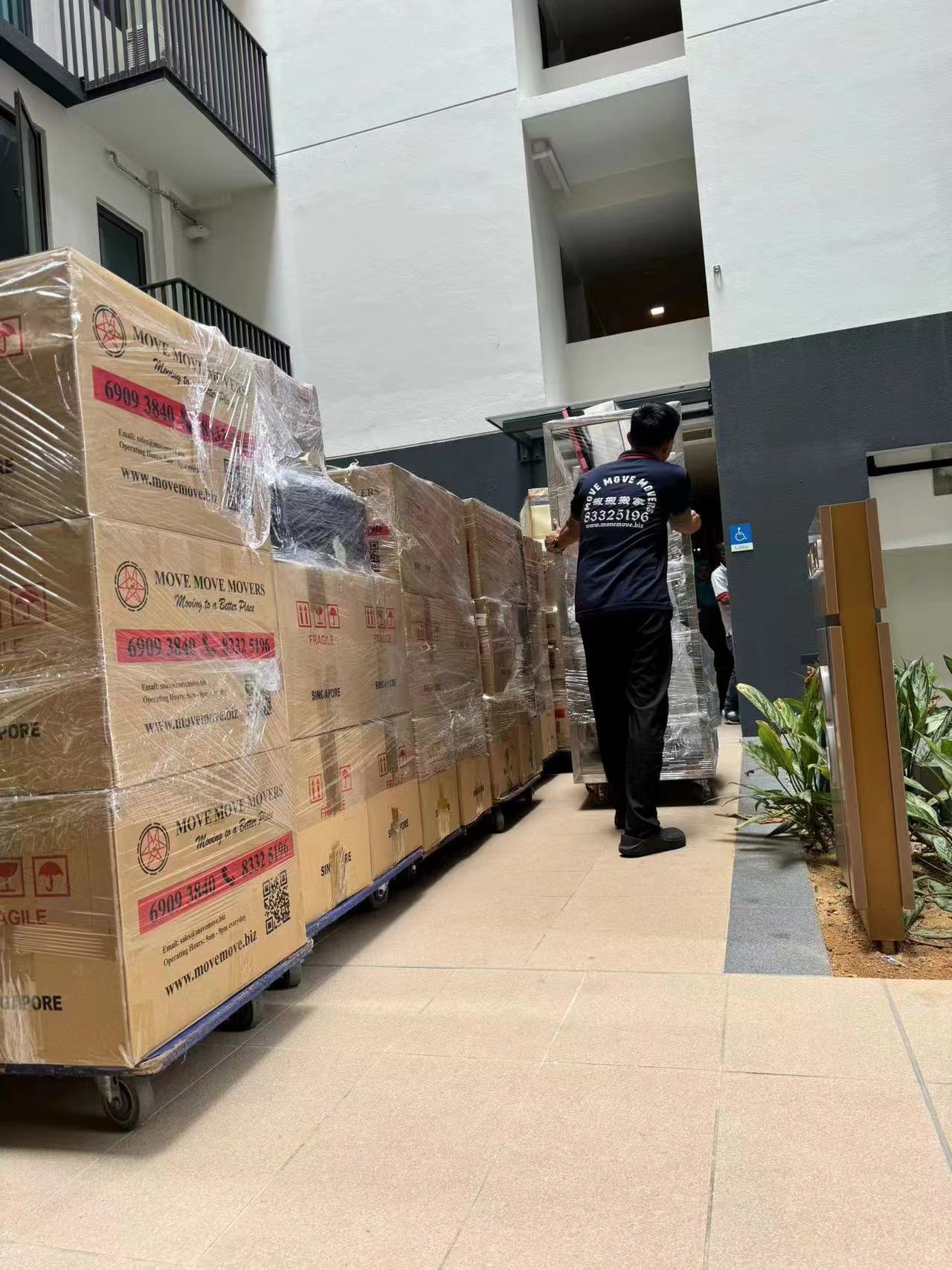
Move Move Movers crew walking beside packed cartons and wrapped furniture along a Singapore condo walkway

Condo moving deposits usually exist because the real moving route includes lift lobbies, corridors, loading areas and shared finishes that must be protected.

What Can You Do If You Do Not Have a Cheque Book?

1. Ask Whether the MCST Accepts PayNow or FAST

Start by asking the management office whether it accepts PayNow Corporate, FAST or a normal bank transfer.

Do not simply transfer money to an account mentioned in an informal message. Request written confirmation of:

  • The full account holder’s name
  • The MCST plan number
  • The PayNow UEN or bank account number
  • The payment reference to enter
  • The proof of payment required
  • Whether an official receipt will be issued
  • How and when the deposit will be refunded

Ideally, the beneficiary displayed by your banking application should correspond to the MCST or its authorised managing agent. Be cautious if you are asked to transfer the deposit into an individual employee’s personal bank account.

PayNow or FAST is generally the simplest arrangement when the MCST is willing to receive the deposit, inspect the common property after the move and refund the money electronically.

2. Ask Specifically About EDP+

Electronic Deferred Payment, or EDP, and EDP+ were introduced in Singapore on 28 July 2025 as digital alternatives to deferred cheque payments.

With a standard EDP, the money is deducted only when the recipient presents the payment. With EDP+, the money is deducted immediately when the payer issues it, reducing the risk that the payer will later have insufficient funds. The service is available through the digital banking platforms of Citibank Singapore, DBS, HSBC, Maybank, OCBC, Standard Chartered and UOB. (Association of Banks in Singapore)

The Association of Banks in Singapore specifically identifies refundable deposits as a type of transaction for which EDP or EDP+ may be suitable.

For a condo moving deposit, EDP+ may be the closest digital equivalent to a secured cheque or cashier’s order because the funds are deducted and reserved when it is issued. DBS, for example, explains that EDP+ funds are held by the bank while waiting for the recipient to cash them out. (DBS Singapore)

However, you cannot unilaterally replace the requested cheque with EDP+. The MCST must:

  • Bank with an EDP-participating institution
  • Be able to receive and present the EDP+
  • Have an internal procedure for recording the deposit
  • Confirm how the deposit will eventually be refunded

Ask the management office about EDP+ by name. Some staff may be familiar with PayNow but may not yet have updated their moving procedures to include this newer option.

3. Ask Whether a Cashier’s Order Is Acceptable

A cashier’s order is a bank-issued physical payment instrument. Unlike a personal cheque, the funds are generally secured when the cashier’s order is purchased.

Cashier’s orders remain available to both retail and corporate users in Singapore. (Association of Banks in Singapore)

Before ordering one, confirm the exact payee name with the management office. MCST names must be entered accurately, for example:

The Management Corporation Strata Title Plan No. XXXX

Processing times and charges vary by bank. As one current example, DBS allows eligible customers to purchase a cashier’s order online, collect it from a selected branch on the next working day or receive it by mail within five working days. Fees also differ depending on whether it is ordered online or at a branch. (DBS Singapore)

A cashier’s order is useful when the management office insists on a physical document but agrees that it does not have to be a personal cheque.

The main disadvantage is the refund process. Ask whether the MCST will refund the deposit through PayNow, bank transfer or another method after the move.

4. Check Whether Your Bank Can Issue a Cheque Without a Cheque Book

Some banks provide limited alternatives for personal customers who do not have a physical cheque book.

DBS, for example, offers an online cheque service through internet banking. The bank prints and mails the physical cheque to a local address. Its current online cheques are valid for two months and can be deposited only into a Singapore bank account. (DBS Singapore)

This can be a practical fallback when:

  • The MCST accepts only a physical cheque
  • You are an eligible customer
  • There is enough time for delivery
  • The management office confirms that a bank-issued online cheque is acceptable

You may also be able to request a new personal cheque book, depending on your bank and account type. Because delivery can take several working days, do not leave this until the day before your move.

5. Avoid Using Someone Else’s Cheque Without Written Approval

Borrowing a cheque from a landlord, friend, relative or property agent may appear to solve the problem quickly, but it can create complications.

The cheque payer may not match the resident named in the moving application. The management office may also refund the deposit to the cheque issuer rather than to you.

Before using a third-party cheque, obtain written confirmation covering:

  • Whether the MCST accepts a cheque from another person
  • Whose name should appear in the payment record
  • Who will receive the eventual refund
  • Whether an authorisation letter is required

Whenever possible, the resident or unit owner responsible for the application should make the payment directly.

Quick Comparison of the Available Options

Payment methodMain advantageMain limitation
PayNow or FASTFast, familiar and easy to refundMCST must agree and provide verified account details
EDP+Funds are reserved immediately; traceable and cheque-likeMCST must support receiving and presenting EDP+
Cashier’s orderBank-issued physical paymentFees, collection time and a separate refund process
Bank-issued online chequeNo physical cheque book requiredAvailable only through certain banks and needs delivery time
New personal cheque bookWorks with traditional MCST proceduresAccount eligibility, fees and delivery time
Third-party chequePossible emergency fallbackOwnership, record-keeping and refund complications

Email Template to Send to Your Condo Management

Subject: Alternative Payment Method for Moving Deposit – Unit [Unit Number]

Dear Management Team,

I am arranging a move for Unit [Unit Number] on [Moving Date].

The moving application requests a refundable deposit by cheque. I do not have a cheque-enabled account or physical cheque book.

Could you please confirm whether the deposit may be paid using one of the following methods?

  1. PayNow Corporate or FAST bank transfer
  2. EDP+
  3. Cashier’s order
  4. A bank-issued online cheque

Please also provide the correct MCST payee name or UEN, payment reference, required proof of payment and the procedure and expected timeframe for the deposit refund.

Thank you.

Kind regards, [Name] [Contact Number]

Do Not Pay the Deposit Until These Details Are Clear

Before sending any money, confirm:

  1. The correct payee

Check the full MCST name, plan number, UEN or account number.

  1. The refund recipient

Establish whether the money will be returned to the resident, owner, landlord or original payer.

  1. The refund method

Ask whether the refund will be made through PayNow, bank transfer or another method.

  1. The refund timeframe

Get an estimated number of working days in writing.

  1. The inspection process

Find out whether you must contact security or the management office after the move to trigger an inspection.

  1. The moving approval status

Payment of a deposit does not necessarily mean the moving application has been approved. Obtain the permit or written confirmation separately.

How to Reduce the Risk of Losing Your Deposit

Before moving begins, take clear photographs or videos of:

  • The lift interior
  • Lift doors and frames
  • The lift lobby
  • Corridor walls and corners
  • Floors along the moving route
  • Loading and unloading areas

Make sure your mover understands the condo’s requirements for lift padding, floor sheets, vehicle height, parking location and permitted moving hours.

Public condo forms show that deposits may be deducted for damage, failure to protect common areas, inadequate cleaning or leaving unwanted items behind. (Marina Bay Residences)

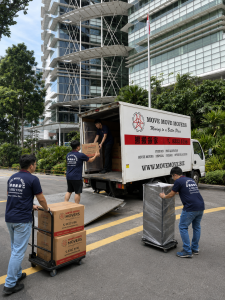
Move Move Movers crew loading cartons and protected furniture from a branded lorry at a Singapore driveway access point

Access details such as driveway position, loading bay timing and vehicle height should be confirmed before the moving slot.

After the move:

  • Remove cartons and packing materials
  • Check the route with the mover
  • Inform security or management that the job is complete
  • Request the post-move inspection
  • Keep the receipt, approval form and photographs until the refund arrives

What Condominium Management Offices Should Change

The corporate-cheque transition is an opportunity for MCSTs and managing agents to modernise moving-deposit procedures.

A practical updated process could include:

  • PayNow Corporate or FAST payment instructions
  • EDP+ as an alternative for deposits requiring greater payment assurance
  • A digital moving application form
  • Automatic payment confirmation
  • Before-and-after inspection records
  • Electronic refund to the original payer
  • A clearly stated refund service standard
  • A named contact for payment disputes

This would reduce administrative work for the management office while making the moving process easier for owners, tenants, property agents and moving companies.

It would also prevent an increasingly awkward situation in which residents must obtain a rarely used banking product solely to satisfy a legacy form.

Frequently Asked Questions

Short answers for residents dealing with cheque-free condo moving deposits and MCST payment instructions.

No. The 2026 change applies to the issuance of new corporate SGD cheque books. Retail customers can still issue and deposit personal SGD cheques after 2026, including personal cheques made payable to corporate accounts.

No. PayNow is normally used for an immediate transfer. EDP+ is a deferred-payment instrument: the money is deducted when the EDP+ is issued, while the recipient subsequently presents it to receive the funds.

Do not assume that every MCST must accept your preferred payment method. Condominium estates exercise self-governance and may have different by-laws and administrative procedures. Ask for the requirement and available alternatives in writing, and escalate the matter to the managing agent or management council if necessary.

There is no single timeframe stated across the public condo moving forms reviewed. Some forms explain the conditions for releasing the deposit but do not promise a specific number of days. Ask the management office to confirm the refund timeframe before paying.

Final Advice for a Cheque-Free Condo Move

Do not wait until moving day to deal with the deposit.

Contact both the condo you are leaving and the condo you are entering as soon as the moving date is known. Their payment methods, lift-booking procedures, notice periods and document requirements may be completely different.

The best sequence is:

  1. Obtain the latest moving form
  2. Reserve the lift or moving slot
  3. Confirm the accepted deposit method
  4. Verify the official payee information
  5. Obtain written moving approval
  6. Brief your moving company on the estate rules
  7. Request an inspection and refund after completion

A professional condominium mover cannot decide which payment method an MCST accepts. However, an experienced mover can help residents prepare the vehicle details, manpower information, access requirements, lift protection and other documents commonly requested as part of the moving application.

Planning a condominium move in Singapore? Speak with Move Move Movers’ condominium moving team or message us on WhatsApp at +65 8332 5196 for a moving assessment and quotation.

Information note: This article is general moving and payment-process guidance, not legal or banking advice. Information was checked against ABS, BCA, bank guidance and publicly accessible condominium moving forms on 25 June 2026. Banking services and estate procedures can change, so residents should verify the latest requirements directly with their bank and management office.

Sources Checked