
Setting Up Your Home Altar & Feng Shui: Rules for Different Deities

5,813 Google reviews










Collecting your keys—whether for a BTO, Resale HDB, or Condo—is a huge milestone for us in Singapore. Aside from hunting for an ID (Interior Designer) and the traditional “Rolling of the Pineapple” for good luck, “Inviting the Gods” (An Shen / 安神) is a critical part of the moving-in ritual for many Chinese families.
A well-placed altar brings peace, harmony, and prosperity to the household. However, did you know that different Deities (Gods) have completely different “lifestyles” and placement rules?
Today, let’s talk about the Feng Shui do’s and don’ts of setting up an altar in your new Singapore home.
In Feng Shui, moving into a new home represents a major shift in energy (Qi). Setting up an altar isn’t just about religious belief; it serves to stabilize the home, attract blessings, and calm the energy. The altar acts as the “spiritual hub” of the house, regulating the magnetic field and providing peace of mind to the residents.
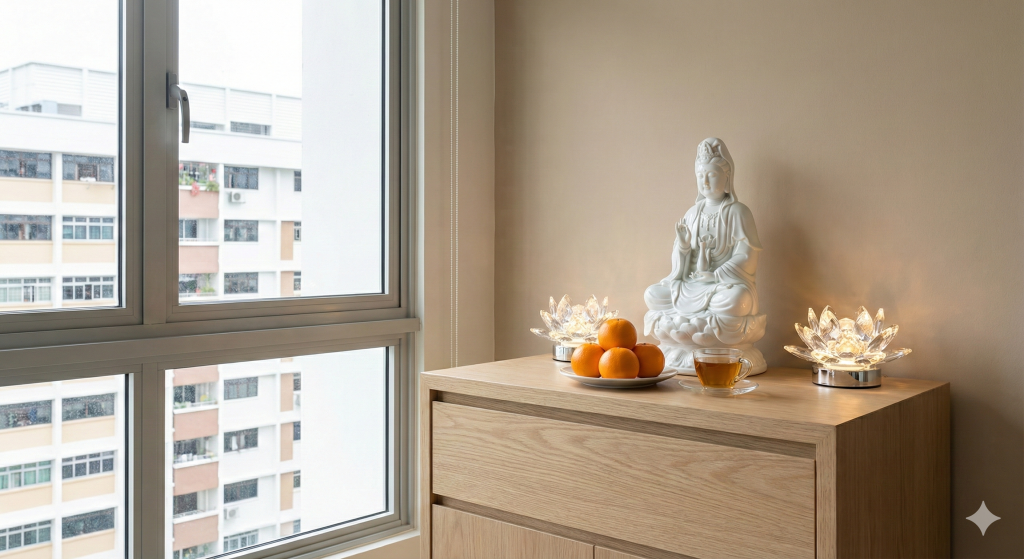
You cannot just place any Deity anywhere. Here are the three most common Deities found in Singaporean homes and their specific requirements:
Guan Yin is the most popular Deity in Singapore, symbolizing compassion and kindness.
Function: Blesses the family with peace, health, and emotional stability.
The Rules:
Strictly Vegetarian: As a Buddhist Bodhisattva, you must NEVER offer meat or alcohol. Only offer fresh flowers, fruits, and water/tea.
Orientation: Ideally sits West facing East (depending on your specific floor plan layout), or facing the main window/balcony.
Taboo: Do not place Guan Yin too close to Guan Gong. One is peaceful (Civil), and the other is fierce (Martial); their energies can clash if placed side-by-side without proper spacing.
Many Singaporean SME owners and sales professionals prefer Guan Gong.
Function: Wards off evil, attracts wealth, and upholds justice.
Civil vs. Martial:
Reading a Book: Suitable for administrative/office workers or students.
Holding a Blade (Guan Dao): Suitable for businessmen, police, or military. The blade usually faces outward to block bad energy.
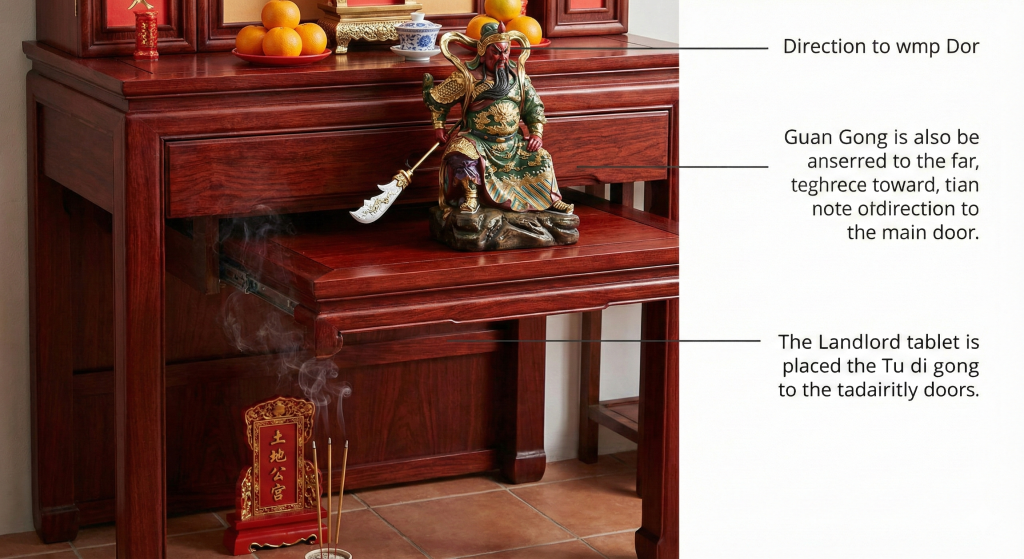
Orientation: Must face the Main Door. Guan Gong is fierce; facing the door allows him to block negative energy (Sha Qi) from entering while inviting wealth in.
In Singapore, you will often see a small red tablet under the main altar. This is the Landlord Deity.
Function: Guardians of the land; they manage the wealth “on the ground.”
Orientation: Must be placed on the floor (usually the bottom shelf of the altar cabinet).
Note: As the “Landlord,” he must be inside the house, not in the corridor.
Whether you live in a compact 3-room BTO or a spacious landed property, these rules are non-negotiable:
The altar must back against a solid wall. It cannot back against a window (symbolizes leaking wealth), a walkway (unstable energy), or an open space. This represents stability for the family.
No Toilet Walls: The back of the altar must never share a wall with a toilet. In Feng Shui, this is considered “filth pressing down on the head.”
No Stove: Do not place the altar backing against the kitchen stove (Fire hazard and “burning” the Deity).
Not Above Door Frames: Do not mount a wall altar above a doorway. People walking under the Deity is disrespectful and causes restless energy.
If you are worshipping both a Deity and Ancestors:
When facing the altar, the Deity goes on the Left (Dragon side / Senior position).
Ancestors go on the Right (Tiger side / Junior position).
The Deity statue must always be slightly elevated/higher than the Ancestral tablet.
Many Singapore condos and HDBs have structural beams. The altar must not be placed directly under a beam. This creates “suppressed” energy, which affects the family’s luck. If unavoidable, use a false ceiling or a covered altar cabinet to hide the beam.
You can’t just buy a statue from Shopee and put it up. It is a ritualistic process:
Date Selection: Consult the Almanac (Tong Shu) or a Feng Shui master for an auspicious date and time for “An Xiang” (placing the incense).
Consecration (Kai Guang): Before bringing the statue home, it should be taken to a temple for a master to “open the light” (consecrate/bless it). A statue without Kai Guang is viewed merely as an art piece or, worse, a vessel for wandering spirits.
Red Cloth: During transport, the Deity’s eyes (or whole body) are usually covered with red cloth to prevent them from seeing “unclean” things on the road. The cloth is only removed once placed on the altar.
First Prayer: At the auspicious hour, place the Deity, light the first incense, and offer your prayers.
Burning Joss Paper: Rituals often involve burning gold paper. Please use the communal bins provided by the Town Council downstairs. Do not burn in the HDB corridor—you will get complaints from neighbors or a fine from the NEA!
LED Candles: For safety (and to prevent blackening your newly painted ceiling), many modern families use high-quality crystal LED lights instead of open-flame candles or oil lamps. It is safer and acceptable.
Space Constraints: For smaller BTO living rooms, wall-mounted altars are popular. Ensure you use heavy-duty brackets so the altar is stable and doesn’t tilt forward over time.
As the saying goes, “Sincerity makes it spiritual.” While there are many Feng Shui rules, the most important aspect is the peace of mind it brings to your family in this busy city.
If you are planning your renovation, try to decide on the altar position early so your ID can design around it (e.g., adding power points for altar lights).
Wishing you a smooth move and Huat ah! 🍍