

2026 Singapore Disposal Services Market Deep Dive: Move Move Movers vs. Pure Disposal Specialists

5,000+ real customer reviews










As Singapore accelerates toward its 2030 Green Plan targets, the disposal services market in 2026 has crystallized into a polarized landscape defined by two distinct operational philosophies: the consumer-centric, digitally integrated logistics model exemplified by Move Move Movers, and the infrastructure-heavy, compliance-driven model of Pure Disposal Specialists such as Tidy Maintenance & Engineering, BNL Waste Management, and Junk to Clear. This report serves as a definitive analysis of this market divergence, evaluating the competitive friction, operational viability, and regulatory compliance of these opposing archetypes against the backdrop of Singapore’s existential waste management crisis.
The urgency of this analysis is underpinned by the finite lifespan of the Semakau Landfill and the escalating enforcement of the Resource Sustainability Act. By 2026, waste disposal is no longer a peripheral facility management concern but a core component of regulatory compliance and corporate reputation management. The market has moved beyond simple “junk removal.” It is now a sophisticated interplay of reverse logistics, resource valorization, and digital trust.
Our exhaustive research indicates that while Move Move Movers has successfully captured the residential “convenience” market through an aggressive aggregation of digital social proof and transparent “trolley-load” pricing, they remain heavily dependent on the downstream infrastructure controlled by the Pure Specialists. Conversely, the Pure Specialists, holding the critical General Waste Disposal Facility (GWDF) licenses and operating physical recovery yards, command the industrial and commercial sectors where audit trails and massive volume processing are paramount. The following sections dissect these dynamics with granular detail, offering a forward-looking roadmap for stakeholders navigating this complex ecosystem.
To understand the strategic positioning of Move Move Movers versus Tidy or BNL, one must first deconstruct the rigorous operating environment of Singapore’s waste sector. The market is not shaped merely by demand and supply, but by a heavy hand of government intervention designed to force a circular economy.
In 2026, the regulatory framework governing waste disposal is tighter than ever. The Resource Sustainability Act (RSA) has matured, imposing Extended Producer Responsibility (EPR) on key waste streams including e-waste, packaging, and food waste.1 This legislation fundamentally alters the liability landscape for disposal service providers. It is no longer sufficient to transport waste away from a site; the provenance and destination of that waste must be accounted for.
The National Environment Agency (NEA) has intensified its oversight, particularly concerning the licensing of waste collectors and disposal facilities. The distinction between a General Waste Collector (GWC) and a General Waste Disposal Facility (GWDF) has become the primary fault line in the industry.
GWC License (Class A/B): This license, held by both movers and specialists, permits the transport of waste. It is a logistics license. Holders must prove they have the appropriate vehicles and can transport waste to a licensed facility.
GWDF License: This is the higher-order credential held by infrastructure players like Tidy Maintenance & Engineering. It authorizes the holder to receive, store, process, or treat waste. This license requires industrial siting consultation, pollution control measures, and rigorous operational capability proofs. It effectively creates a high barrier to entry, protecting incumbents who own land and machinery from asset-light disruptors.
The cost structure of disposal in Singapore is heavily influenced by the gate fees (tipping fees) at Waste-to-Energy (WtE) incineration plants and the Semakau Landfill. To discourage waste generation, the government has pursued a policy of progressively increasing these fees. By 2026, the cost per tonne for disposing of incinerable and non-incinerable waste has risen significantly, putting pressure on margins.
Incinerable Waste Fee: Revised upwards to incentivize recycling.
Non-Incinerable Waste Fee: Drastically increased to preserve Semakau’s lifespan.
This inflationary pressure impacts the two business models differently. Pure Specialists like Tidy, who own sorting facilities, can mitigate these costs by extracting recyclables (wood, metal, concrete) from the waste stream before sending the residue to the incinerator. They practice “waste valorization”. In contrast, logistics-only providers who simply transport “raw” waste to the incinerator face full exposure to rising tipping fees, necessitating either higher prices for consumers or squeezed margins.
Perhaps the most significant behavioral driver for consumers in 2026 is the fear of liability. High-profile enforcement cases, such as the fining of a supervisor for dumping furniture at Kheam Hock Road , have permeated public consciousness. With penalties reaching $50,000 or imprisonment for first-time offenders , and the widespread deployment of surveillance technology, the reputational and legal risk of engaging an unlicensed or “rogue” contractor is prohibitive.
This environment favors established brands with visible compliance markers. “Trust” has become a commodity. Consumers are willing to pay a premium for a service provider that guarantees legally compliant disposal. This shift has fueled the rise of companies like Move Move Movers, who leverage their massive volume of Google Reviews as a proxy for reliability and safety, effectively marketing “peace of mind” alongside furniture removal.
The “Uberization” of Residential Disposal
Move Move Movers represents a paradigm shift in how residential disposal is consumed. By treating disposal not as a standalone industrial service but as a value-added feature of the relocation process, they have captured a significant share of the household market.
The most formidable asset possessed by Move Move Movers is their digital reputation. In an industry historically plagued by information asymmetry—where consumers fear hidden costs, damage to property, and fly-by-night operators—Move Move Movers has engineered a fortress of social proof.
Volume as Validity: With over 4,300 verified Google Reviews and a 4.9-star rating , they eclipse traditional waste companies in digital visibility. Tidy Disposal, a giant in the industrial space, holds roughly 250+ reviews. This order-of-magnitude difference is not accidental; it is the result of a deliberate strategy to digitize the customer feedback loop.
The “Trust Score”: Analysis suggests that Move Move Movers dominates the “Trust Score” metric, a composite of rating quality and review volume. For a 2026 homeowner scrolling through options on a smartphone, this numerical dominance signals safety. The psychological implication is that “4,300 people can’t be wrong,” reducing the perceived risk of the transaction.
Staff Personification: Reviews frequently name specific team members (e.g., “Simon and his team” ), humanizing the service. This stands in stark contrast to the faceless, industrial interface of traditional waste collectors.
Move Move Movers has disrupted pricing models by adopting a consumer-friendly vernacular. While industrial firms quote in tonnage or cubic meters (metrics unfamiliar to laypeople), Move Move Movers utilizes “Trolley Load” counting and itemized pricing.
Transparency: Customers can send photos via WhatsApp to receive a fixed quote. This immediacy aligns with the “on-demand” economy expectations of 2026. The quote includes labor, transport, and disposal fees, eliminating the fear of hidden surcharges.
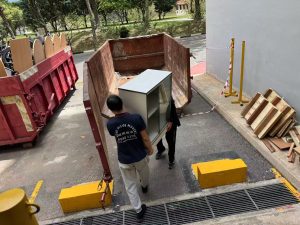
Micro-Logistics Capability: Their core competency is moving. This means their staff are trained to dismantle bed frames, protect lift lobbies with padding, and navigate tight condominium corridors. A pure waste collector, accustomed to using a crane to lift an Open Top Container (OTC), may lack the finesse required to extract a grand piano or a built-in wardrobe from a 30th-floor apartment without damaging the property.
The “Pushing” Factor: They have standardized charges for “long pushing” distances (e.g., from lift to loading bay) and staircases. While some consumers complain about these surcharges, the transparency of having them listed prevents disputes, unlike the ad-hoc negotiation often found with informal operators.
The brilliance of the model lies in the integration. Disposal is rarely a standalone event for households; it usually coincides with a move, a renovation, or the purchase of new furniture. By offering “Disposal Services” alongside “Residential Moving,” Move Move Movers captures the customer upstream.
Economy of Scope: The truck is already booked. The manpower is already on-site. Adding disposal items to the job card incurs a lower marginal cost than dispatching a dedicated disposal truck. This allows them to be price-competitive for “mixed” jobs (move + dispose).
Partnership Ecosystem: They have established partnerships with platforms like Home Service Singapore , further embedding themselves into the homeowner’s lifecycle. They act as the logistics arm for a broader ecosystem of home services.
Despite their dominance in residential “micro-disposal,” Move Move Movers faces structural limitations compared to pure specialists.
Asset-Light Vulnerability: They are primarily a logistics company, not a waste processor. They do not appear to hold a GWDF license. This means they must pay gate fees to third-party facilities (like Tidy’s yard or NEA incineration plants) to offload waste. They are price-takers in the disposal market, vulnerable to tipping fee hikes.
Volume Constraints: Their fleet consists primarily of box trucks (10ft, 14ft, 24ft) designed for furniture. They are ill-equipped to handle loose construction debris, wet waste, or massive industrial clear-outs that require open-top skips and compactors.
The Industrial Backbone of Singapore
While Move Move Movers wins the “digital popularity contest,” the Pure Disposal Specialists constitute the physical backbone of Singapore’s waste management infrastructure. Companies like Tidy Maintenance & Engineering and BNL Waste Management operate on a different scale, focusing on industrial capability, resource recovery, and regulatory compliance for heavy waste streams.
Tidy is the archetype of the “Pure Specialist.” With 40+ years of operation, their value proposition is built on heavy assets and licensure.
The GWDF Advantage: Tidy holds the coveted General Waste Disposal Facility (GWDF) license. This allows them to operate a physical yard at 29 Tuas Ave 8 where they can accept, sort, and process waste.
Vertical Integration: By owning the facility, Tidy captures the margin that logistics-only players lose to gate fees. They can sort recyclables (scrap metal, wood, paper) and sell them, turning a disposal cost into a revenue stream. This “waste valorization” capability is a critical competitive advantage in a high-cost environment.
Fleet Diversity: Their fleet is not limited to moving trucks. It includes Rear-End Loaders (REL) for general waste, Hooklifts for massive Open Top Containers (OTCs), and recycling lorries. This allows them to serve construction sites, shopping malls, and industrial parks—sectors Move Move Movers cannot effectively penetrate.
Brand Modernization: Recognizing the threat of digital disruption, Tidy underwent a significant rebranding exercise, adopting the tagline “We’re happy when it’s Tidy” and using orange as a distinct corporate color to stand out from the “green” crowd. This signals an intent to compete for brand recall, even if their primary moat is industrial.
BNL positions itself higher up the value chain, focusing on “Integrated Environmental Services” and corporate sustainability.
Smart Infrastructure: BNL deploys Smart Compactors, Food Digestors, and Smart Bins. These are IoT-enabled devices that optimize collection schedules and provide data on waste generation. This appeals to corporate clients (MNCs, hotels) who need granular data for their ESG (Environmental, Social, and Governance) reporting.
Circular Economy Focus: They operate a recovery facility at 40 Penjuru Road and emphasize “Waste Valorisation” and “Digital Twins” technology. BNL is the partner for companies that need to prove they are reducing their carbon footprint, offering “Mandatory Waste Reporting” services that go far beyond simple removal.
Holistic Facility Management: As part of a group that also offers landscaping and cleaning , BNL can bundle disposal into a comprehensive facility management contract. This “sticky” relationship makes them difficult to displace.
Junk to Clear carves out a niche based on speed and security, bridging the gap between residential needs and specialized disposal.
Priority Same-Day Service: Their operational model is tuned for urgency. When a tenant needs to vacate a property immediately or an office needs to clear out clutter before a VIP visit, Junk to Clear offers a responsiveness that scheduled movers often cannot match.
Secure Destruction: A critical differentiator is their capability for Secure Disposal. They offer certified destruction of confidential documents and proprietary products (e.g., uniforms, prototypes), providing a chain of custody that is essential for corporate clients concerned with IP theft or data security.
Karang Guni Heritage: They explicitly reference the “karang guni” tradition , positioning themselves as a modernized, professional version of the traditional rag-and-bone man, which resonates with local cultural nostalgia while offering professional reliability.
The market is not a monolith; it is segmented by need. The following analysis contrasts the two models across key performance indicators relevant to the 2026 consumer.
The pricing models of the two groups reflect their different operational constraints.
Move Move Movers (Itemized Certainty):
Model: Fixed price per item or per “trolley load.”
Pros: High predictability for consumers. “What you see is what you pay.” Excellent for low-volume, high-mix jobs (e.g., “one sofa, two chairs, three boxes”).
Cons: Can become expensive for high-volume, low-value waste (e.g., 50 bags of renovation rubble). The labor component is a significant portion of the price.
Hidden Costs: Consumers must be wary of “pushing fees” (distance from lift to truck) and “staircase fees” if the lift doesn’t stop on the floor.
Pure Specialists (Volume Scale):
Model: Price per tonne, per bin pull (OTC), or contract-based.
Pros: Economies of scale. Renting a 10-tonne skip from Tidy is far cheaper per cubic meter than paying a mover to cart it away by hand.
Cons: “Opaque” for the average homeowner. Minimum charges often apply. You pay for the bin whether you fill it or not.
Suitability: Ideal for renovation contractors, landed property owners with driveways, and industrial clients.
Access & Protection: Move Move Movers wins on “micro-logistics.” Their teams are trained to protect parquet flooring, wrap lift interiors, and dismantle complex IKEA furniture. Tidy’s drivers are experts at maneuvering heavy trucks, but their crews may not offer the white-glove dismantling service required inside a luxury condominium.
Permits & Admin: For a condo move, Move Move Movers likely handles the management office paperwork (deposits, lift booking). For a skip tank rental from Tidy, the homeowner often needs to ensure the skip placement doesn’t violate LTA parking rules or MCST by-laws, creating higher administrative friction for the user.
Regulatory Shield: Engaging Tidy or BNL provides the highest level of regulatory insulation. Their GWDF licenses are a matter of public record. For a corporate compliance officer, this is non-negotiable.
Trust Proxy: For a homeowner, Move Move Movers’ 3,000 reviews act as a proxy for regulatory compliance. While they may strictly be a transporter, the sheer volume of successful jobs suggests they are not illegally dumping. However, the actual chain of custody is less transparent than with a facility owner.
In the circular economy of 2026, the path of waste is as important as its removal. The analysis reveals a complex downstream ecosystem.
The relationship between Move Move Movers and firms like Tidy is essentially symbiotic.
The Aggregator (Move Move): Acts as the “First Mile” collector. They consolidate waste from hundreds of residential points. They perform a preliminary sort—diverting usable furniture to charities and recyclables to “approved facilities.”
The Processor (Tidy/BNL): Acts as the “Middle Mile” and “End of Life” solution. The “approved facilities” Move Move refers to are likely the yards owned by Tidy, BNL, or similar GWDF licensees. Here, the waste is shredded, separated, and prepared for the WtE plants or recycling streams.
For priority streams like e-waste, the supply chain involves specialized partners.
KGS Pte Ltd and Virogreen are identified as key partners for e-waste bins and collection. While Move Move Movers collects e-waste, they likely channel it to licensed EPR partners like KGS to ensure compliance with the Resource Sustainability Act.
Earth Recycling Services plays a niche role here, focusing heavily on the dismantling and sorting of electronics and metals to maximize recovery rates.
Consumers in 2026 are wary of greenwashing.
Move Move Movers leverages the emotional appeal of donation. “Donating to charity” is a powerful narrative that assuages consumer guilt about waste.
BNL/Tidy rely on the technical reality of industrial recycling. Their sustainability claims are backed by “Waste Audits” and tonnage reports , which appeal to the rational, compliance-driven corporate buyer.
The market has not converged; it has specialized. The friction between the two models is minimal because they serve different masters: Convenience vs. Compliance.
Digital Integration: We predict Move Move Movers will deepen their technological edge, possibly using AI to automate “trolley load” estimation from photos, further reducing the friction of quoting.
Regulatory Squeeze: As illegal dumping surveillance improves, “man with a van” operators will be squeezed out, driving more volume to compliant aggregators like Move Move Movers and specialists like Tidy.
Cost Pass-Through: Rising tipping fees at WtE plants will force logistics-only players (Move Move) to increase prices. Asset-heavy players (Tidy) who can valorize waste (sell recyclables) will have more pricing elasticity.
For the Residential Consumer (HDB/Condo):
Choose Move Move Movers if your priority is convenience and protection. If you need furniture dismantled, moved out of a high-rise, and the quantity is less than a full renovation load, their integrated labor/transport model is the most efficient. The higher cost per item is offset by the elimination of hassle and the assurance of property protection.
For the Landed Property Owner / Renovator:
Choose Tidy Maintenance & Engineering if you have volume. If you are clearing a garden, stripping out a kitchen, or have a driveway to accommodate a bin, renting an OTC from Tidy is significantly more cost-effective. Their industrial capacity handles “rough” waste that movers might reject or overcharge for.
For the Corporate Facility Manager:
Choose BNL Waste Management or Tidy. The requirement for waste reporting, audits, and GWDF licensing makes them the only viable options for legally compliant corporate waste management. Move Move Movers is suitable only for ad-hoc office relocations, not ongoing waste streams.
For the Urgent/Sensitive Requirement:
Choose Junk to Clear. If time is the critical variable (same-day vacate) or if the material is sensitive (branded goods, hard drives), their specific focus on priority and secure destruction creates a value proposition that neither movers nor industrial haulers effectively address.
In 2026, the “best” disposal service is contextual. Move Move Movers has successfully “uberized” the residential sector, winning on interface and trust. Pure Specialists have fortified the industrial sector, winning on infrastructure and compliance. The smart consumer does not ask “who is cheaper,” but “what is the nature of my waste?” For the sofa in the condo, call the mover. For the rubble in the driveway, call the engineer.
Please contact us if you have any questions that are not answered on this page. We have a team of experienced customer service representatives who can help you with any moving-related questions you may have.
In TOP season, yes. We can coordinate MCST lift booking and loading bays, provide lift liners and floor protection, and supply photo evidence after the job.
We use shrink-wrap and waterproof covers, stage under shelter, and prefer covered paths. Electronics/art go in moisture-safe crates with desiccants.
We run 2.1 m closed lorry inside and transfer to larger trucks outside, or split components to fit service lifts and doorways.
Often yes. If your time window is tight, we pre-pack the evening before and deliver big items and essentials the next day.
Yes—same in-house crew packs, dismantles, moves, and reassembles, so timelines stay tight and quality stays consistent.
MCST forms/deposits, lift booking reference, loading bay location, security contact, and a carry-with-you box for essentials.
Basic coverage is included; extended options are available for high-value furniture, art, or gym equipment.
Yes. We can bundle disposal with your move so it’s one crew, one schedule.

Move Move Movers
#05-35 3 Soon Lee Street, Singapore 627606 Tel: 6909 3840 HP: 8332 5196
Copyright 2019-2024 Move Move Movers. All Rights Reserved.